Inside ASML
We visited ASML's Retail Investor Day: Chip Shortage for 2-3 years?!
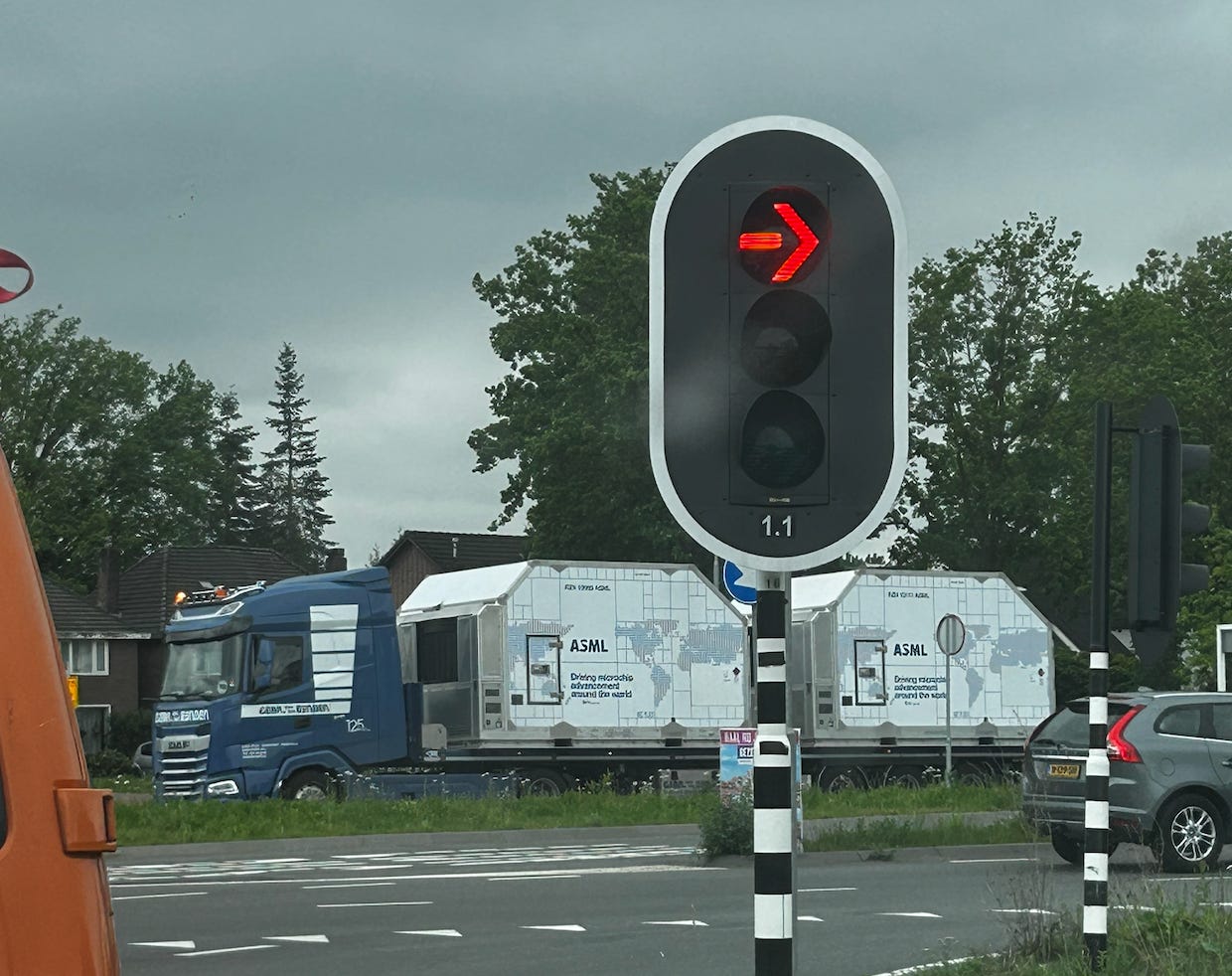
This week, we were lucky enough to visit ASML’s headquarters in Veldhoven and ask some unique questions. A huge thank you to ASML for making this all possible! Even before we arrived, the experience had already begun: during our drive to the ASML campus, we actually spotted a truck transporting two chip machine components. How cool is that?!
The Staggering Complexity of ASML
When ASML started in a leaky shed on the Philips campus, there was no room to build everything in-house. Today, over 80% of all components that go into an ASML machine are outsourced. This has led to a gigantic network of over 5,000 component suppliers. In Veldhoven, all those individual parts are finally assembled into their famous DUV and EUV machines.
But this logistical network isn’t where ASML’s complexity ends; it’s where it starts. For instance, Zeiss (a key supplier of ASML’s mirrors) has over 1,200 suppliers of its own. Every supplier in this chain needs to scale up (and down) with ASML’s demand. A key question we had was: what happens when a vital supplier can’t scale or innovate? That could become a massive bottleneck for future growth. ASML actively mitigates this risk by relying on multiple suppliers, providing capital injections, and sometimes even through acquisitions. Still, the risk of a “bottleneck supplier” isn’t unthinkable and remains on the radar.
Another layer of complexity lies in its people. In a fiercely competitive labor market, how do you attract and retain the right talent? ASML counters this with excellent benefits, high salaries, and the lure of working on exceptionally challenging problems. The result is an impressive attrition rate of just 4.1%, while the industry average sits at roughly 10%.
Pressure on Veldhoven
When you think about it, it’s almost surreal that the most complex (and perhaps the most important) machines on earth are assembled in a small village in the Netherlands. Not Silicon Valley, not San Francisco, not even Amsterdam, but Veldhoven.
Naturally, ASML’s explosive growth puts immense pressure on the local community. With 15,000 ASML employees concentrated in Veldhoven, housing prices have skyrocketed due to the massive surge in demand. This strain extends to the local infrastructure, resulting in an overloaded power grid, as well as shortages in everyday necessities like schools and dentists. To help alleviate this, ASML is co-investing in public facilities with the municipality and expanding to a new campus in Eindhoven to take some of the pressure off Veldhoven.
Efficiency Improvements? Customers Pay.
One fascinating takeaway from the day was how ASML handles machine upgrades. The company constantly makes minor improvements to existing machines to increase wafer throughput and improve yield. However, customers pay for these upgrades through higher Average Selling Prices (ASPs).
As Sam van der Zalm, Head of Investor Relations Europe, put it:
“The average selling prices of the machines grew at roughly the same rate as the efficiency improvements of the machines.”
China: Scaling Down
In Q1 2026, China accounted for just 19% of total ASML sales, the lowest in years. Compare this to just two years ago in Q1 2024, when sales to China accounted for a staggering 49% of total revenue. Fortunately, this decrease was expected and has been absorbed by demand from other countries, such as Taiwan (TSMC) and South Korea (Samsung).
On Share Buybacks
Jan Klein Poelhuis from FortyTwo Capital asked an excellent question: wouldn’t it make more sense to do opportunistic buybacks when shares are trading at a discount, instead of consistently buying back roughly the same amount? We strongly agree; shares should only be repurchased when they are internally assessed as undervalued. By not doing so, ASML leaves potential shareholder returns on the table, which is a shame. Van der Zalm responded that ASML deliberately avoids timing the market, as they do not want to signal to investors whether they believe the stock is over- or undervalued.
The Photonic Chip Threat

Catchy headlines about the rise of photonic chips often make investors nervous, as ASML isn’t specialized in building machines for them. When asked how they view this risk, Van der Zalm noted that they listen closely to their customers, “stay paranoid,” and collaborate with companies like Smart Photonics to manage any potential shift in chip technology well.
Nevertheless, a classic innovator’s dilemma could unfold: ASML doesn’t currently seem positioned to benefit from a widespread shift from silicon to photonic chips. This remains an important development for investors to monitor closely.
Machine Uptime
We always assumed ASML machines operated 24/7, 365 days a year. However, during the tour, we learned that while DUV machines boast an uptime of over 95%, EUV machines “only” have an uptime of 80-85%. That means ASML’s most complex machines are actually offline for about 4.8 to 5.5 hours a day (of 24 hours)! That’s significantly more downtime than we anticipated.
💡 Fun fact: From the moment an order is placed to the final installation, it takes ASML 6 to 12 months to deliver an EUV machine.
A 2-3 Year Chip Shortage?
After the presentation, we toured the ASML Experience Center and had the opportunity to chat with an ASML employee. He shared that he is personally heavily invested in semiconductor companies like ASML, Lam Research, and TSMC.
His investment thesis? He expects the current chip shortage to last at least another two years. He explained that supply is heavily constrained, and scaling up takes 2-3 years since you simply can’t build new fabs overnight. Meanwhile, demand remains sky-high and continues to rise following recent AI announcements from hyperscalers. He expects this severe demand/supply disconnect to persist for quite some time.
Conclusion
Our visit provided incredible insights into the staggering engineering behind ASML. It is abundantly clear why no single person can fully comprehend an entire ASML machine, and why the required knowledge is so deeply fragmented. We received some highly unique information during this trip, and we hope you enjoyed these takeaways!
PS: You still have the opportunity to become a TDI Member at a permanent 50% discount! You’ll receive biweekly fundamental analysis, industry reports, access to an all-in-one investment terminal, and entry into a community of like-minded investors.
Best,
Bouke, Mathijs & Siem
The Dutch Investors