

The Secret Behind Serial Acquirers
Mastering the art of acquisitions

The secret behind serial acquirers
Many investors stay away from companies that grow by buying other companies. Research shows that 80% of all acquisitions don't create value for the acquirer. Problems often include paying too much and not getting the expected benefits. Common pitfalls include overly optimistic synergy expectations, failure to realize economies of scale, overpayment, and ego-driven decisions by executives.
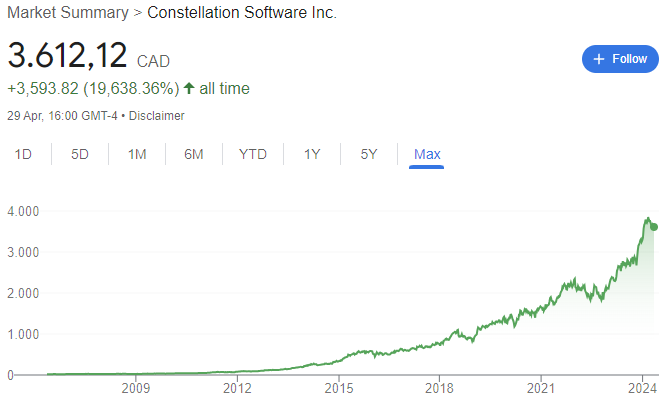
However, some companies, known as serial acquirers, often buy other businesses and do it successfully. Examples include: Constellation Software, whose value has increased by 20.000% since 2006, and Topicus, up 80%+ since 2021. These companies show that buying businesses can be a good strategy.
Understanding Serial Acquirers
Serial acquirers, a distinct breed in the investing world, are companies strategically acquiring others as a core element of their growth strategy. While the general perception might be that most takeovers fail, there exists a niche group that excels in this art.

The attraction of investing in these 'takeover machines' lies in their remarkable capacity to reinvest most of their (if not all) free cash flow for extended periods with impressive returns. This unique trait allows shareholders a hands-off approach, sparing them in the constant pursuit of profitable businesses. Exceptional serial acquirers not only execute this proficiently but also enhance diversification, gradually mitigating risks with each strategic takeover.
Important traits of serial acquirers include:
Smart spending: They know how to use their capital well, buying businesses that will give them high returns on invested capital.
Less risk: By buying different kinds of businesses, they spread out their risk, which can protect them if the market changes. Many serial acquirers focus on a particular niche, buying businesses only within that area. This approach helps them maintain a competitive edge by building on their high levels of expertise, experience, and market control.
Smart leaders: The success of these companies often depends on their leaders, who need to pick the right businesses to buy and combine them into their company successfully.
Serial acquirer dynamics
Investing in a serial acquirer transcends mere support for a thriving company; it's a bet on talented managers (CEOs). The essence lies in their efficient internal processes, ensuring the wise investment of excess capital at exceptionally high returns for years to come.
Serial acquirers can be divided into four main buckets:
roll-ups;
platforms;
accumulators;
and hold-cos.
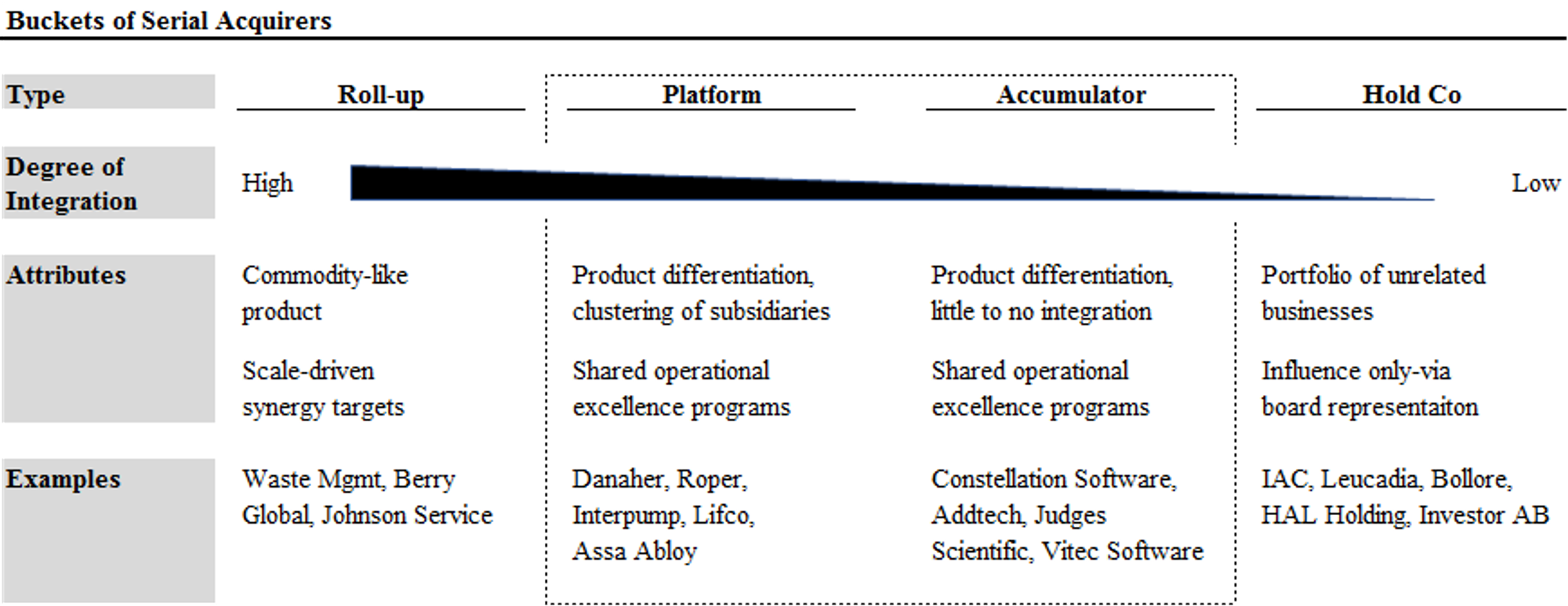
Serial acquirers can be categorized into four types: roll-ups, platforms, accumulators, and hold-cos. Platforms, exemplified by Danaher and Roper, serve as bases for further acquisitions, while accumulators, like Constellation Software, steadily expand their portfolios. Roll-ups focus on consolidating smaller companies in the same sector, and hold-cos, represented by Berkshire Hathaway, manage diverse entities without direct involvement in daily operations.
Each bucket contributes uniquely to the overarching strategy, pursuing economies of scale, acting as a foundation for future acquisitions, steadily expanding portfolios, or managing diverse entities without daily operational involvement.
Successful serial acquirers, following in the footsteps of industry giants like Berkshire Hathaway, instill substantial autonomy in the acquired companies. This approach fosters a mutually beneficial relationship, solidifying their reputation and making them attractive options for potential sellers.
Returning value to shareholders
A common thread among thriving companies, including serial acquirers, is the commitment to creating shareholder value. When lucrative investment opportunities are scarce, these companies choose to return excess cash to shareholders, contributing to sustained trust and confidence.
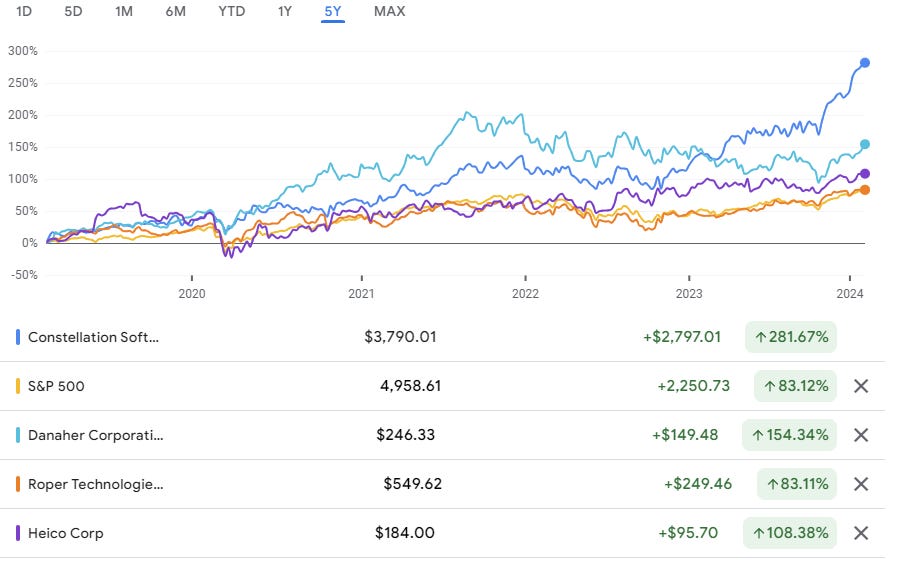
The research underscores that companies consistently employing acquisition strategies tend to outshine their peers. Serial acquirers like Constellation Software, Danaher, Roper, and Transdigm achieve substantial returns, surpassing benchmarks like the S&P 500.
Serial acquirer strategies
Putting money into companies that buy other companies often requires a deep understanding of their plans and skilled management. These investments are more than just backing a company; they show a well-thought-out plan that stays in place even when takeover chances are slim. The repeatable way of thinking that led to their successful acquisitions is still a big part of how they can keep making money for their owners. It's tempting to invest in serial acquirers, but you need to do a lot of study on the industries they work in first.
Most investors by now know the power of strong, excellent serial acquirers, most of these businesses trade at very expensive valuations. Might be justified, might not be. Only time will tell.
Constellation Software
Curiously, a significant number of serial acquirers come from Sweden. The reasons behind this geographical concentration remain somewhat unknown.
Notably, there isn't a strict way to define a company as a serial acquirer. For example, Constellation Software easily completes around one hundred deals every year, which is different from how companies like LVMH do things.

As a "software's superorganism," Constellation Software is one of the best serial acquirers in the world at making profitable deals. Constellation, led by Mark Leonard, does better than most businesses because it uses a unique management style that is similar to how ant colonies act as a decentralized, collective whole. This way of doing things makes Constellation work more like a living ecosystem, with many connected but separate parts that all work together to make the whole company successful.
The organization of Constellation's operating groups is similar to that of the parent company, but on a smaller scale. Each group works almost independently. Because of this set-up, each group can specialize and respond quickly, which makes it possible to handle a wide range of software companies well.
The way Constellation runs its business is very different from more organized, control-based methods. Leonard supports a way of managing that gives significant freedom to each boss within the operating groups. This idea of "delegation to the point of abdication" is very important for giving managers power and creating a place where efficiency and new ideas can grow. Leonard believed that less control can lead to more productive results, and this method allows for a light but effective touch of oversight. This philosophy has been shown to work by Constellation Software's significant growth.
The overhaul paradox
Some takeovers don't work out as planned because of something called the "takeover paradox." Like stock buyback plans, merger and acquisition activity is highest when the economy is doing very well. Because they are too sure of themselves and get bonuses based on sales, management often goes after deals too much, even if the risks are higher than the benefits.
Multiple studies from universities have shown that most of the time, mergers and acquisitions don't improve the performance or profits of the business that buys another one.
What sets serial acquirers apart?
The crucial question arises: what sets serial acquirers apart?
To do good fundamental research on a company, you need to know how each of them works. Since they have done so many acquisitions, serial acquirers build an in-house team that can handle the complexities of each deal, so they don't have to hire as many expensive experts. Over time, being able to make acquisitions that work out becomes a competitive edge.
Serial acquirers must be very disciplined when making purchases. It can be tempting to pay too much for a company you want, but the consequences can be big, especially when it comes to future returns. Serial acquirers depend on keeping a high hurdle rate, which is the lowest return an investment needs to be successful. This hurdle rate of about 25% is very high for companies like Constellation Software. This tight rule makes sure that all free cash flows are re-invested with a minimum 25% return every year. This increases the chance that share value will continue to rise.
By lowering the hurdle rate, Constellation Software expands the universe of potential acquisitions. That comes at a cost, though, namely, the rate of return for the entire portfolio. Leonard (CEO of Constellation Software) outlines both bull and bear cases in one of his letters to shareholders:
One of our directors has been calling me irresponsible for years. His thesis goes like this: CSI can invest capital more effectively than the vast majority of CSI's shareholders, hence we should stop paying dividends and invest all of the cash that we produce, even if it means lowering our hurdle rates.
I used to argue that we needed to maintain our hurdle rates because dropping them for a few marginal capital deployments would cause the returns on our entire portfolio to drop.
Leonard then says that he has changed his mind, which means that CSI (Constellation) can now make deals with lower hurdle rates. Along with that choice, CSI has also decided to start buying bigger companies more often. The last time Constellation did this was in 2013, when it bought Total Specific Solutions (TSS) for €240 million. In 2020, it bought Topicus for €217 million. (Constellation later merged the businesses and spun them off under the name "Topicus.")
The art of constant buying
Constellation Software is a good example of how hard it is to make a lot of deals every year. In order to do this, deals are often decentralized, meaning that each subsidiary gets help, information, and money to go after its own acquisitions. With this decentralized method, many companies can buy other companies all the time. For example, Constellation Software keeps a shortlist of over 30.000 possible targets. Focusing on vertical market software (VMS) that targets specific areas helps a lot of small VMS companies around the world do well.
Serial acquirers usually gain from multiple expansions (increasing PE and/or P/FCF-ratio), because they tend to buy smaller companies for less than their worth. This characteristic gives them an added short-term benefit on top of the long-term success you get from buying good companies at low prices and getting high returns on your investment.
Conclusion
In conclusion, the success of serial acquirers depends on their skill in consistently finding, buying, and blending companies into their operations. This process helps them grow, spread their risks across different businesses, and reduce potential losses. Although there are always challenges, learning about how these companies operate offers important lessons for investors interested in this complex area of business. Understanding their strategies can be very helpful for anyone looking to invest in such companies.
